Writing / 2026-03-19
Steel Bracing Design Calculation Note
Simplified checks of steel bracing for multi-storey buildings including storey loading, sway check, axial force checks, and load path.
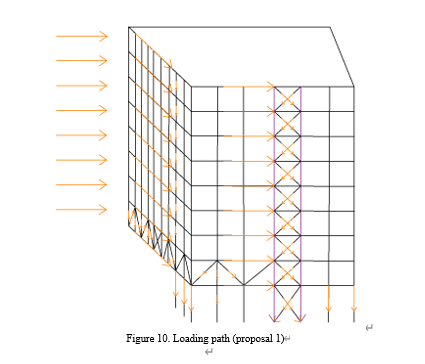
This note presents the preliminary design check for the critical vertical steel bracing bay. A simple braced frame arrangement is assumed, so the floor system transfers lateral load to the braced bay and the braces carry the load to the foundation. The critical bay is checked at the bottom storey because it carries the largest cumulative horizontal action and the largest cumulative vertical action.
Design basis
- Floor dead load: 7.0 kN/m²
- Roof dead load: 6.0 kN/m²
- Selected design level: Level 1
- Storey height at critical level: 6 m
- Brace length: 9.605 m
- Bracing section: 305 × 305 × 283
- Steel grade: S355
- Elastic modulus: 210000 N/mm²
- Area A: 36000 mm²
- Number of active diagonals: 2
- cos θ: 0.781
The horizontal force at each level was taken as F = W + NEd/200, where W is the wind action and NEd/200 represents the notional horizontal force due to vertical load imperfection. The cumulative horizontal design action at the base of the storey was then taken as HEd = ΣF. The vertical action at each floor was evaluated using V = wAB/2.
Storey loading and cumulative actions
From the tabulated storey loads, the critical base level was governed by a cumulative horizontal design action of HEd = 6116.9 kN and a cumulative vertical action of VEd = 240570 kN. These values were then used for the sway stability check and for the brace member force checks.
Global sway check
The sway stability parameter was evaluated using αcr = (HEd / VEd) × (h / δH,Ed). The horizontal deflection of the X-bracing was calculated from δH,Ed = (HEd L) / (2AE cos²θ), where L is the brace length, A is the brace area, E is the elastic modulus, and n is the number of active diagonals.
Using HEd = 6116.9 kN, L = 9.605 m, A = 36000 mm², E = 210000 N/mm², and cos θ = 0.781, the horizontal deflection was calculated as δH,Ed = 6.37 × 10⁻⁶. This gave αcr = 23.96. Since αcr is greater than 10, first-order analysis was considered acceptable and second-order effects did not need to be included in the global sway check.
Brace axial force and tension resistance
The brace axial force was evaluated using NEd = HEd / (n cos θ). Substituting HEd = 6116.9 kN, n = 2, and cos θ = 0.781 gave NEd = 3917 kN.
The design tension resistance was calculated from Nt,Rd = Afy / γM0. With A = 36000 mm² and fy = 355 N/mm², the resulting tension resistance was Nt,Rd = 12780 kN. Since Nt,Rd > NEd, the brace was satisfactory in tension.
Compression resistance
The compression check was then carried out using the elastic critical load, non-dimensional slenderness, reduction factor, and design buckling resistance. The critical load was calculated as Ncr = π²EI / Lcr² = 5527 kN. This gave a non-dimensional slenderness λ̄ = 1.521.
Using the selected buckling curve with α = 0.49, the imperfection factor expression gave φ = 1.980 and a reduction factor χ = 0.308. The final design compression resistance was therefore Nb,Rd = χAfy / γM1 = 3935.3 kN.
Since Nb,Rd > NEd, the brace was also satisfactory in compression. Therefore, the selected bracing member was adequate for both tension and compression under the governing design action.
Bracing arrangement and load path
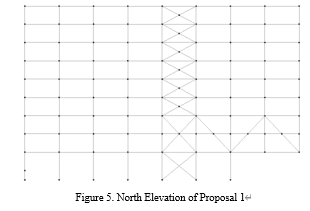
The overall structural arrangement and the assumed load path are important because the design depends on the floor system collecting lateral loads and transferring them into the selected braced bay. The figures below illustrate the north elevation bracing layout and the assumed load path for Proposal 1.