Writing / 202
Equivalent Young's Modulus of Hexagonal and Triangular Lattices
A structural analysis coursework note comparing theoretical and MATLAB stiffness-matrix predictions of the effective Young's modulus of two-dimensional hexagonal and triangular lattice structures.
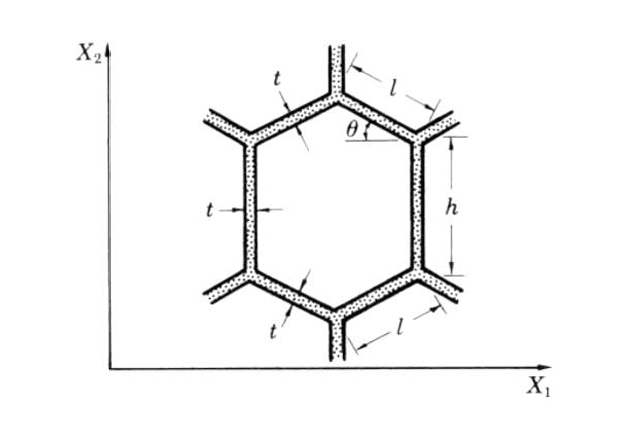
This coursework investigates the equivalent Young's modulus of two-dimensional lattice structures, with a focus on regular hexagonal and equilateral triangular unit cells. The work compares a theoretical approach based on published expressions with a computational approach implemented in MATLAB using the matrix stiffness method.
Aim
The main aim of the report is to replicate part of the work of Gibson and Ashby through a computational stiffness-matrix implementation. By analysing two-dimensional hexagonal and triangular lattices, the study evaluates their effective Young's modulus and checks whether loading in the horizontal and vertical directions leads to the same result.
Theoretical approach
The report adopts theoretical expressions for the effective Young's modulus of lattice materials. For a regular hexagonal lattice, the report uses Ex* = Ey* = (4/√3) Es (t^3 / l^3). For an equilateral triangular lattice, the report uses Ex* = Ey* = (2/√3) Es (t / l). These expressions are then rewritten in the general form Ei* = α Es ρ̅^β.
Relative density is introduced as a key geometric parameter. The study uses several relative density values, including 0.05, 0.10, 0.15, 0.20, and 0.25. Steel is used as the parent material in the calculations, and the report states a solid Young's modulus Es of 2000 MPa.
Computational approach
The computational part of the work uses MATLAB and the matrix stiffness method to calculate lattice displacement under point loading. The effective Young's modulus is then recovered from E = F L0 / (A ΔL), where F is the applied load, L0 is the original characteristic length, A is the reference area, and ΔL is the displacement.
Individual member stiffness matrices are formed, transformed to global coordinates, and assembled into the full structural stiffness matrix. The method is applied to both hexagonal and triangular lattices under horizontal and vertical loading.
Hexagonal lattice
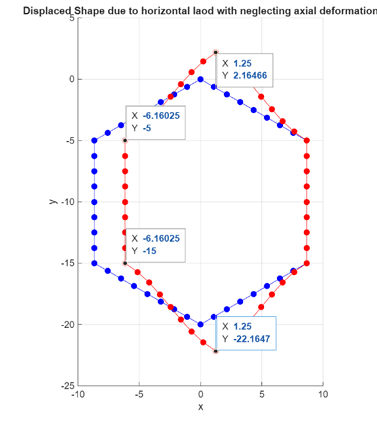
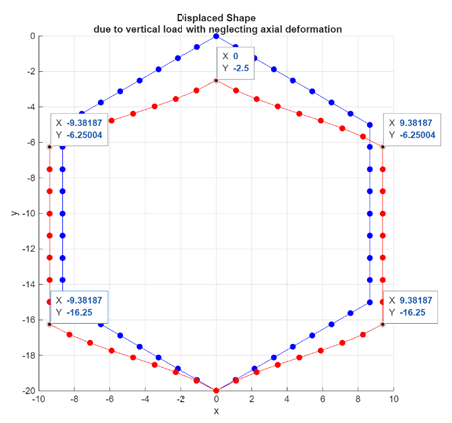
For the regular hexagonal lattice, the structural members were taken with l = h = 10 mm. The lattice was analysed under both horizontal and vertical loading in order to calculate Ex* and Ey*. In one part of the study, axial deformation was neglected by assigning a very large axial rigidity EA so that the model focused primarily on bending behaviour.
When axial deformation was neglected, the stiffness-matrix results reproduced the theoretical behaviour closely and showed that Ex* and Ey* were effectively the same. This supports the report's objective of verifying that the equivalent Young's modulus is independent of loading direction under the adopted assumptions.
When axial deformation was included, the results deviated more clearly from the simplified theory. The report notes that the fitted parameter α changed significantly, while the change in β was relatively small. Based on this, the coursework suggests that α is more sensitive to axial rigidity EA, whereas β is more closely related to flexural rigidity EI.
Triangular lattice
The triangular lattice part of the report derives the effective stiffness from Hunt's theory and then validates it using the MATLAB stiffness-matrix model. The computational results for Ex* and Ey* are very close to each other and remain close to the theoretical prediction across the tested relative densities.
The report states that the difference between Ex* and Ey* for the triangular lattice is small, and that the average error is low. This supports the conclusion that the equilateral triangular lattice behaves as an in-plane isotropic system under the assumptions used in the coursework.
Validation using different point loads
Different point loads were also applied to confirm that the computed equivalent Young's modulus remained unchanged under linear elastic scaling. The report uses this as an additional validation of the stiffness-matrix implementation.
Main conclusion
Limitations
- The stiffness-matrix method assumes linear elastic behaviour.
- The study does not represent yielding or plastic deformation under large loads.
- Only a single hexagonal or triangular cell is extracted, so the model does not fully represent real lattice assemblies.
Future work
The report suggests extending the work to multi-cell lattice models and performing finite element analysis for stress analysis. It also notes that different boundary conditions, especially fixed connections between cells, may lead to different results in a more realistic model.